
The Challenge
In the early 2020s, the construction industry in Lenawee, Jackson, and Hillsdale counties in Michigan experienced a critical workforce shortage. It needed a pipeline of talented tradespeople to fill the positions that would be vacated by its aging workforce within the next five to ten years. At the same time, it struggled to attract new talent and upskill existing workers due to a lack of nearby training programs.
The Solution
Recognizing the urgent need for skilled talent, Lenawee Now—an economic development organization focused on workforce development—stepped in to address the gap. In 2023, it received a grant to purchase or renovate a facility and establish the Align Center for Workforce Development (Align Center), which subsequently became an independent nonprofit organization. The Align Center's mission is to identify and address regional training gaps.
In 2023, Lenawee Now also received state grant funding to initiate employer-led collaboratives that support the Align Center’s efforts. Jack Townsley, a consultant with Lenawee Now and a TPM® Fellow, assembled 12 employers from the construction trades across Lenawee, Jackson, and Hillsdale counties. This industry collaborative represents a wide array of construction trades, including electrical, plumbing, general contracting, commercial contracting, flooring companies, and Heating, Ventilation, Air Conditioning, and Refrigeration (HVACR).
“It was an easy decision to join the collaborative,” says employer partner Andrew Greenwell, president of Whitcher Plumbing & Heating. “Contractors complain about how there are not enough qualified people to do the work. If I have an opportunity to make some improvements, then I feel obligated to do so. Being part of the collaborative is a way to help bridge our labor gap.”
Before convening partners, Lenawee Now had already identified that the construction industry faced major talent challenges, so the collaborative’s first step was to agree upon shared strategies. Employer partners determined that adult training and youth engagement were their top priorities.
The collaborative’s next step was to identify the skills that they wanted their entry-level talent to develop. Employer partners from different trades determined that they required identical foundational skills. They also agreed that it was in their self-interest to promote each other’s trades “because you can't do my trade without other trades,” explains Andy Carver, owner of Adrian Mechanical. “There's a lot of work that we subcontract out to other trades. Many other trades hire us to do various projects. We need each other.”
-
40,600
Michigan's projected annual openings in the professional trades by 2032.
Providing Technical Skills Training for Adults
The Align Center is accredited by the National Center for Construction Education and Research (NCCER) to offer trades training and certify instructors. It also certifies instructors to use the curriculum and proctor online tests.
In 2025, responding to employer priorities, the Align Center launched four-year programs in key fields such as plumbing and HVACR. It will soon start offering courses like frontline supervision and site superintendent training. It is one of only a few sites in Michigan to provide these kinds of programs. As Townsley puts it, “In Michigan, outside of the training provided by the unions, which strictly limit enrollment, there were few options for adult training, and none in our region.”
In the first year, trainees begin by building core cross-functional skills in basic shop math, power tools, and safety protocols, and continue to learn skills in a specific skilled trade. In the following years, they learn more technical skills in their trade of choice. By the time they graduate, they become highly skilled trade professionals.
The Align Center also partners with the Floor Covering Education Foundation (FCEF) to provide basic floor covering installation training. All its instructors are experienced trade professionals who have a passion for their trade and a desire to give back to the community. FCEF provides a $2,500 subsidy to each student, and in the pilot year of the program, Lenawee Now was able to leverage grant dollars to cover the remaining cost for the participants.
Enhancing Youth Engagement
Employer partners emphasize the importance of sparking student interest in careers such as electrical, plumbing, HVAC, and carpentry. They participate in career fairs and visit schools to build awareness and interest in the trades. “Kids are our future pipeline of talent. We have to put in the work to get them interested in the trades so that the labor market can look different in 10 to 20 years,” says Greenwell.
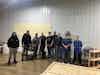
In March 2025, the collaborative hosted a Spring Break Construction Trades Camp for middle school students. Hosted by the Align Center and organized by its community partner, The Shop Rat Foundation, the camp involved employee volunteers from plumbing and HVAC companies. Students participated in hands-on projects throughout the week including:
- Building their own toolboxes
- Soldering pipes together
- Constructing mock walls with drywall
- Exploring HVAC systems
The camp not only introduced students to practical skills but also gave them a glimpse into rewarding career paths, sparking curiosity that could grow into a long-term interest in the trades.
Best Practices
As the initiative has evolved, the collaborative—working with partners across industries—has established best practices for implementing the TPM approach. These lessons apply to a wide range of sectors, and include:
- Survey employers at the beginning of in-person meetings to identify evolving needs.
- Persist through low attendance and adjust schedules to fit business cycles.
- Engage middle and high school students early to build positive perceptions of careers in the trades.
Looking Ahead
When the grant ends in September 2025, the collaborative will transition into a quarterly advisory committee, sustained through the Align Center. Its growth will depend on employer demand. “We can grow it as much as employers need us to because we have a demand-driven model,” says Townsley. “TPM’s methodology brings together employers that have common needs and addresses them through the tools of the Align Center. This demand-driven model positions the collaborative for long-term sustainability.”


