

Published
September 17, 2026
A new national survey from the U.S. Chamber of Commerce Foundation complicates the picture of a fractured country: teens are just as worried about America’s problems as their parents, but they are not giving up on solving them.
The U.S. Chamber of Commerce Foundation’s third annual Civic and Economic Literacy Survey, conducted in partnership with RXN, included 1,000 registered adult voters and 1,000 teens ages 13 to 17 from across the United States. It found that 71% of teens say the issues they believe deserve national attention can eventually be fixed, compared with 64% of adults.
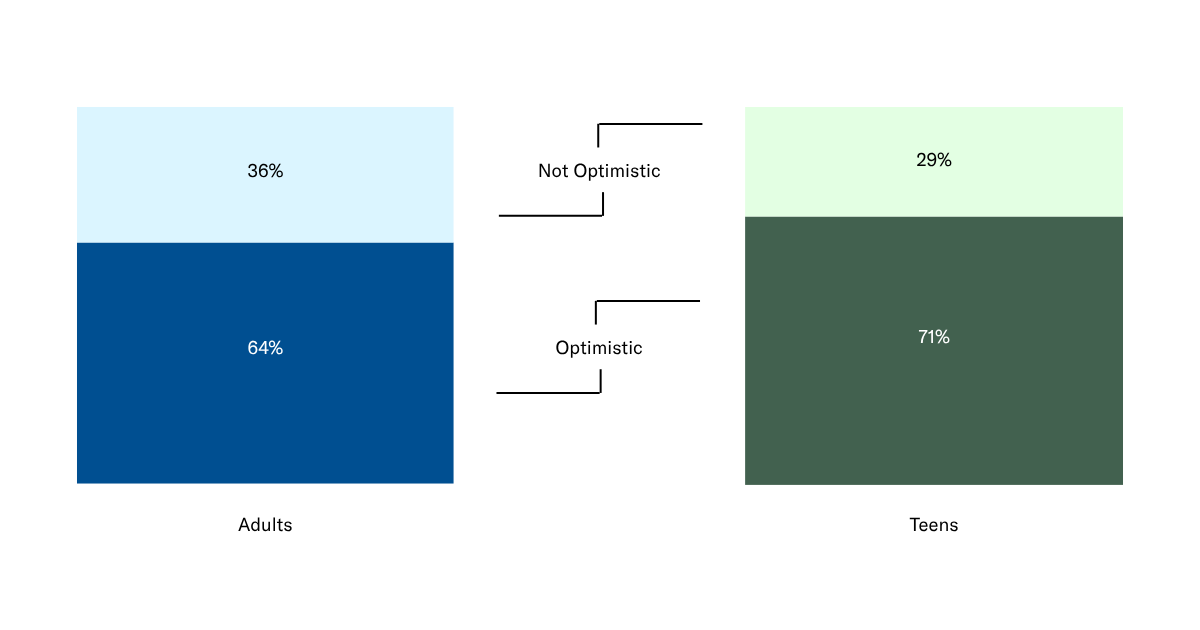
That optimism does not mean teens are unaware of the country’s challenges. Eighty-eight percent of teens and 89% of adults say America is politically divided, and majorities in both groups are dissatisfied with how democracy is working. Yet the survey also reveals meaningful common ground across generations to drive solutions.
Common Ground Across Generations
The survey shows striking agreement between adults and teens on several building blocks of civic life. One of the strongest points of shared confidence is small business: 91% of adults and 90% of teens view small businesses favorably. Among the civic skills measured, supporting local businesses was also the area where both groups gave the country its strongest marks.
There are also some important differences in how adults and teens define what contributes to the nation’s success. Among adults, 93% say understanding how government works and voting in federal elections is important. Among teens, 94% say understanding government, supporting local businesses, and listening to people with different viewpoints is important.
The Gap Between Belief and Practice
Ninety-one percent of adults say listening to people with different viewpoints is important, but only 49% believe the country is doing it well. Teens see the same disconnect: 94% call the skill important, yet only 49% say it is working well.
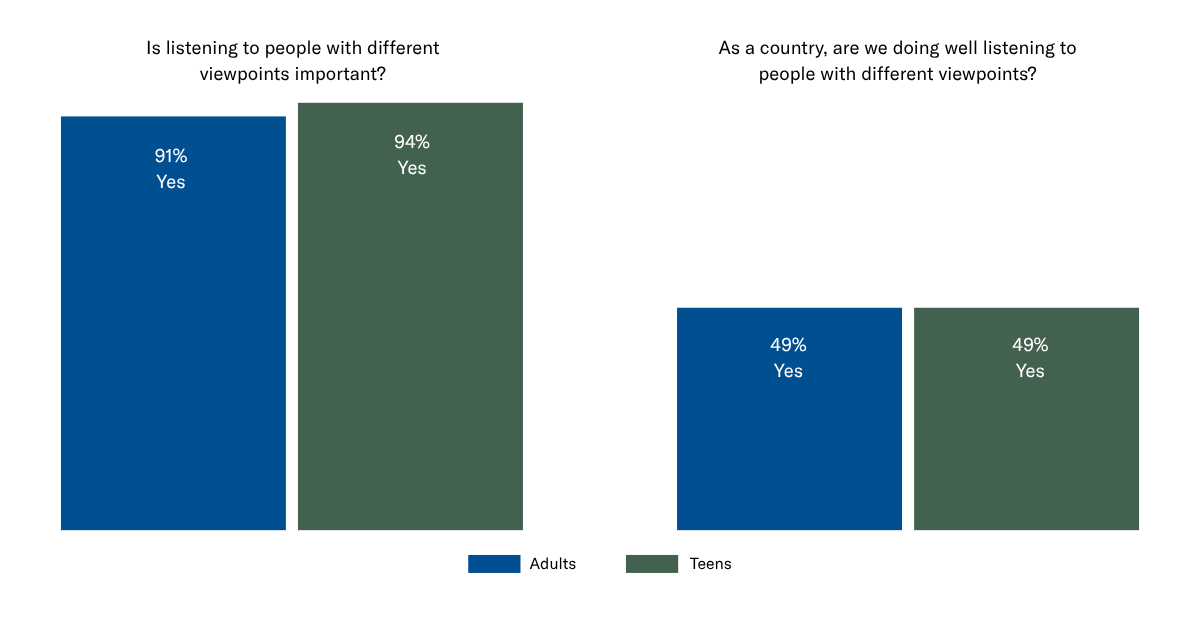
That disconnect points to the need for civic education and community practice. People need more than a general belief in democracy or civil dialogue; they need regular chances to understand how decisions are made, weigh competing ideas, and work through disagreement in constructive ways.
Knowledge Gaps Hold People Back
The survey also found that confidence does not always match understanding. Sixty-eight percent of adults say they could explain how the U.S. system of government works to someone from another country, but only 56% answered six or more of the survey’s 10 civic knowledge questions correctly. Among teens, 58% say they could explain the system, while only 46% answered six or more questions correctly.
Economic literacy showed a similar pattern. Only 47% of adults and 49% of teens answered five or more of the eight economic literacy questions correctly, and only about one in 10 demonstrated the strongest levels of economic literacy measured by the survey. Those gaps are especially important because economic concerns remain top of mind, with managing the economy and affordability ranking among the top priorities for both adults and teens.
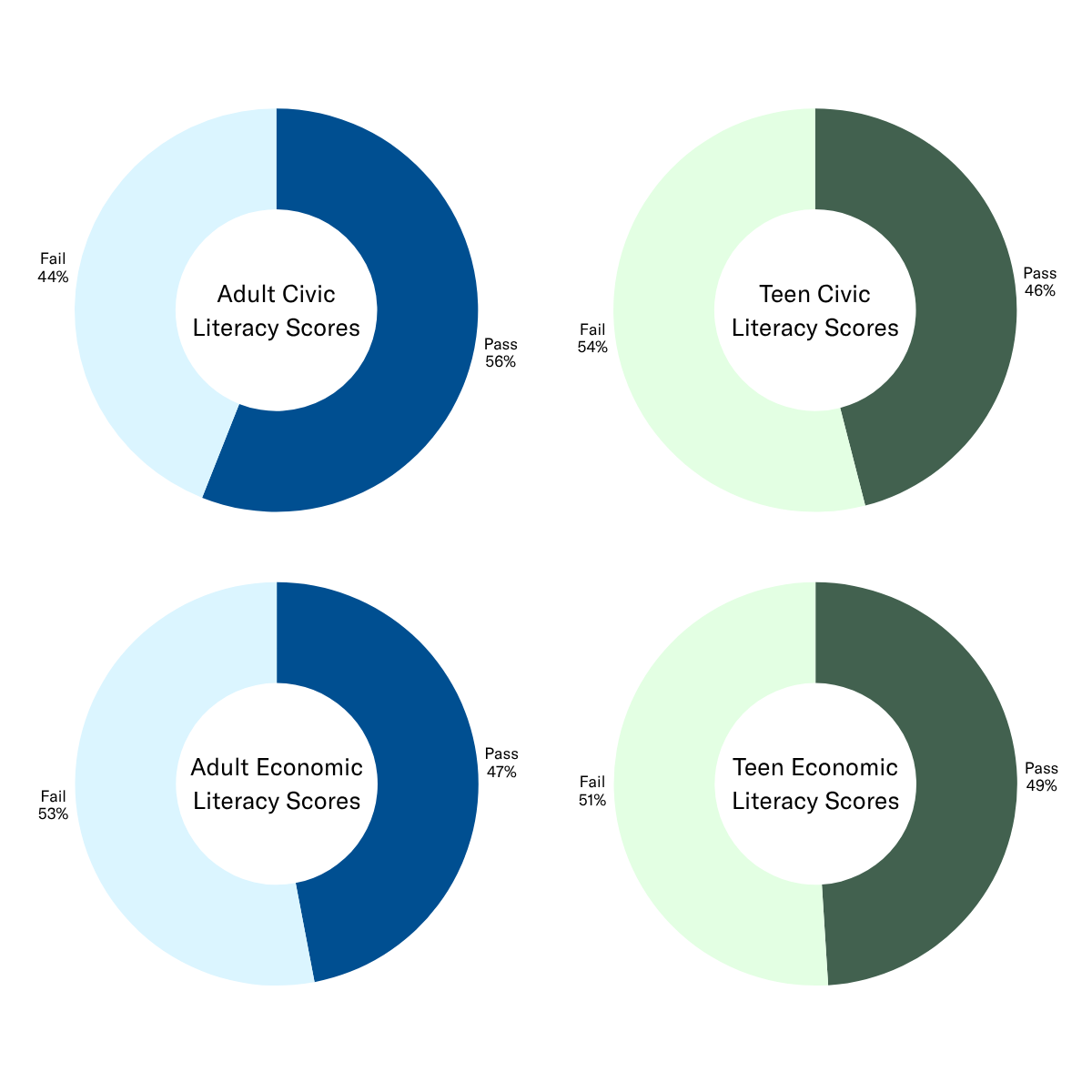
Those shortfalls matter because Americans are making decisions every day as voters, workers, consumers, and community members. Understanding government without understanding the economy leaves people with only part of the picture when they are trying to evaluate policy choices or understand how public decisions affect their lives.
Why the Teen Findings Matter
The teen results are especially illuminating because they complicate a common assumption that young people are disconnected from civic life. Teens in the survey recognize serious problems, including housing, the economy, inflation, and health care. But they are also more optimistic than adults and more likely to believe the country can work through the issues they care about.
That combination should matter to educators, employers, policymakers, and community leaders. Young people are paying attention, and they are not yet disheartened. The question is whether they will be given meaningful ways to build knowledge, test ideas, and see themselves as part of civic life before frustration hardens into disengagement.
Giving People a Place to Practice
The survey does not suggest that civic confidence can be rebuilt through information alone. People also need settings where they can practice the habits democracy requires: listening across differences, asking better questions, understanding tradeoffs, and working with others to solve real problems.
These are not only civic skills. They are also skills workplaces and communities depend on: critical thinking, communication, problem-solving, collaboration, and the ability to navigate disagreement productively. Employers have a direct stake in whether young people and adults are prepared to participate constructively, not only as voters, but as workers, consumers, neighbors, and community leaders.
That is why business has a role to play. Through the U.S. Chamber Foundation’s Civic Trust®, Civics@Work helps employers create space for adults to build civic understanding and put those skills to use in the workplace and beyond. The National Civics Bee® gives students a chance to study how government works, identify challenges in their communities, and propose solutions.
The survey’s most hopeful finding is not that Americans agree on everything. They do not. It is that Americans of all ages still agree on enough to build from, and the next generation still believes the country’s problems are worth trying to solve. The next step is to give more people the preparation and real-world practice to help solve them.
Get the latest news and resources, including more from our Civic and Economic Literacy Survey, delivered straight to your inbox.