Americans remain deeply supportive of the civic institutions that give ordinary people a direct voice in public life. Jury service is one of the purest examples of democratic participation. It asks citizens to actively deliberate, weigh evidence, listen to different perspectives, and help administer justice. It is democracy not as a spectator sport, but as a shared responsibility. So why aren’t more people serving?
The U.S. Chamber of Commerce Foundation’s third annual Civic and Economic Understanding Survey, conducted in partnership with RXN Group, asked 1,000 registered adult voters and 1,000 teens about their views on jury service and the barriers that can prevent participation. One of its most compelling findings is that jury service does not suffer a legitimacy problem; it suffers from a participation problem. Americans overwhelmingly value jury service and recognize its importance in maintaining a healthy democracy, yet many encounter practical obstacles that prevent them from serving when called.

Understanding Jury Service
Teens scored slightly higher than adults on jury duty knowledge questions, but both groups demonstrated room for improvement. When combined with the fact that the most common post-summons questions center on logistics and expectations, the findings point to a clear opportunity: improving public understanding of jury service could help transform civic participation.

Barriers to Jury Service
For many Americans, serving on a jury creates uncertainty. Work, health concerns, caregiving responsibilities, and family obligations are among the leading reasons individuals do not ultimately serve after being summoned. As the population ages and more Americans care for children, parents, or family members, these competing responsibilities increasingly influence whether citizens can fulfill their jury obligations.
Unlike personal or family circumstances, work-related challenges can often be mitigated through better communication, clearer employer guidance, and greater awareness of employee rights and protections. Many Americans are willing to serve but are uncertain about how jury duty will affect their jobs, income, schedules, and workplace responsibilities. The survey found that after receiving a jury summons, the most common questions revolve around logistics.
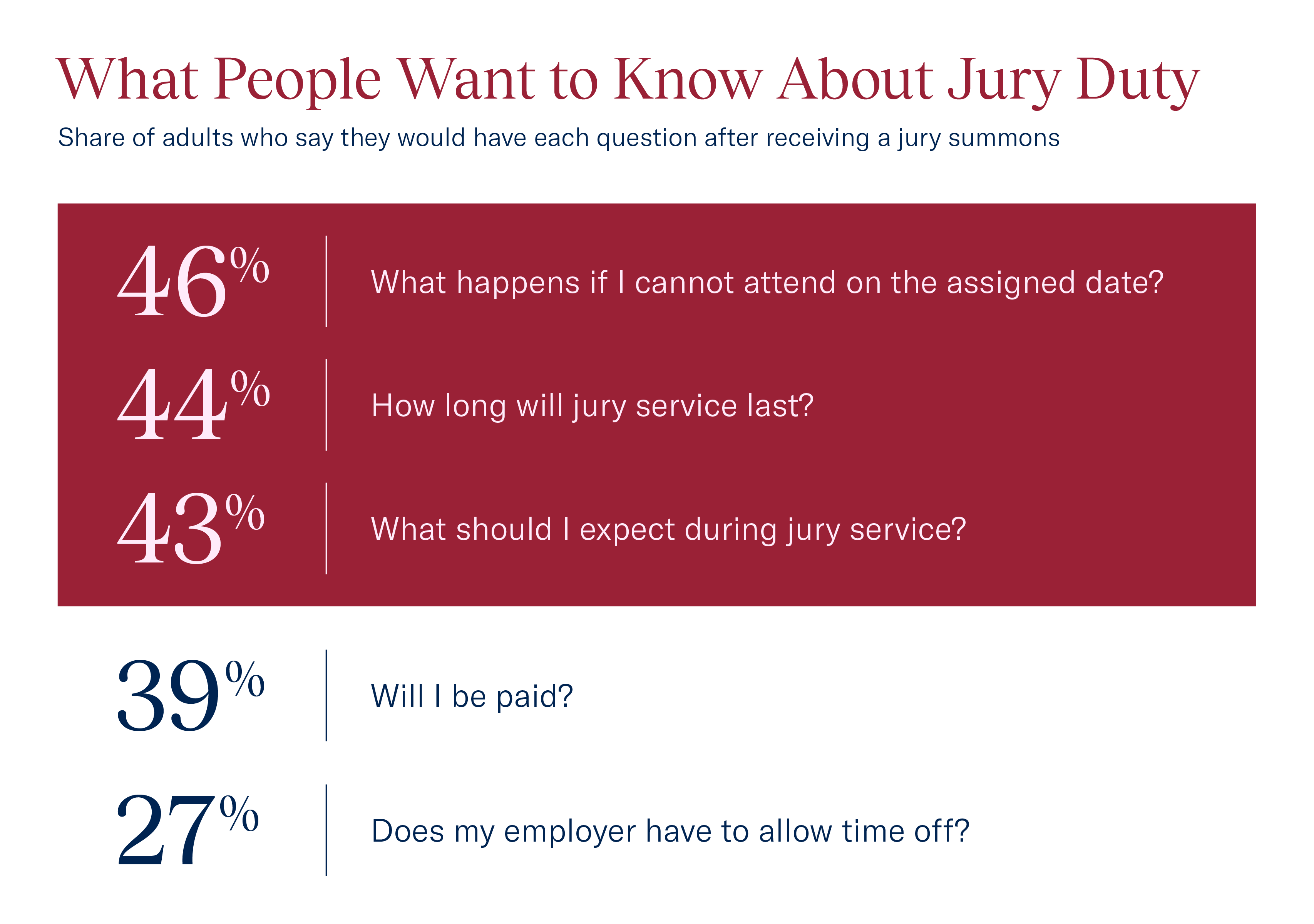
Closing this participation gap requires more than reminding Americans that jury service matters. It requires practical support: clearer information about what to expect, stronger workplace understanding, and resources that help prospective jurors manage the real-life demands of serving.
How the Juror Education Project Can Help
The survey found that adults who receive a jury summons frequently turn to employers for answers and want more information about how jury duty affects their work obligations. The Juror Education Project capitalizes on this opportunity by helping employers provide employees with clear, timely information when they receive a summons.
Imagine an employee receives a jury summons but is unsure whether they can miss work, whether they will be paid, or how long service will last. Faced with uncertainty, they may seek a postponement, exemption, or—in many cases—fail to respond at all. Through employer-distributed resources, workplace education campaigns, and clear explanations of the jury process, the Juror Education Project can answer these questions before they become barriers.
By equipping employers and employees with accurate, accessible information about jury service, the project is designed to reduce the logistical and informational obstacles that often prevent participation. In doing so, the project aims to make jury service easier to understand and navigate, helping more Americans prepare to participate when called.
When citizens cannot participate because of logistical barriers, courts lose access to representative juries, communities lose opportunities for civic engagement, and individuals miss one of the few experiences that brings diverse Americans together around a shared public responsibility.
If you are interested in bringing The Juror Education Project to your workplace or exploring national distribution partnerships, please complete our contact form.
About the author

Pamela Sharma
Pamela manages Civics@Work initiatives at the U.S. Chamber of Commerce Foundation.