The State of Civic and Economic Understanding in America 2026


Published
October 27, 2026
- Introduction
- Half of Americans Still Fail Basic Civics Tests
- Attitudes Remain More Positive Locally Than Nationally
- Economic Concerns Outpace Economic Understanding
- The Next Generation Has Concerns, But Significant Optimism
- A Failing Report Card: We Are Performing Poorly on the Building Blocks to Our Nation’s Success
- Including Teens in 2026: The Future Generation is Taking Part Now
- How Do We Move Forward? Give People a Place to Practice
- Methodology
Introduction
Across generations, Americans overwhelmingly agree that civic participation matters. Yet this year's findings reveal a persistent challenge: many lack the knowledge, confidence, and opportunities needed to fully participate. For the third consecutive year, The Civic Trust, a nonpartisan initiative of the U.S. Chamber of Commerce Foundation, partnered with RXN Group to examine Americans' civic and economic knowledge, attitudes, and participation.
The results reveal both cause for concern and hope. More than nine in 10 adults and teens say that understanding how government works, supporting local businesses, voting, and sustaining a healthy democracy are important to the country's success. At the same time, many believe the nation is falling short in these areas. Only about half believe Americans are doing well at understanding how government works, and fewer than half think the country is doing well at listening to people with different viewpoints, despite overwhelming agreement that both are essential.
The survey also highlights a persistent gap between confidence and civic and economic knowledge. Most Americans believe they could explain how the U.S. government works, yet many struggle to answer basic questions about civic institutions and economic principles. Fewer than half correctly identified the length of a U.S. senator's term, the number of U.S. Supreme Court justices, or key concepts underlying how markets and economic systems function.
Still, the story emerging from this year's findings is not one of disengagement. Despite gaps in civic and economic knowledge and concerns about the state of civic life, Americans continue to show a strong desire to participate. The challenge is not convincing Americans that civics matters. It is helping them turn that belief into knowledge, skills, and meaningful participation.
The Civic Trust is working to meet that challenge. Through initiatives such as the National Civics Bee® and Civics@Work, The Civic Trust helps young people and adults build the knowledge, skills, and habits needed to participate effectively in their communities. At a time when Americans remain united on the importance of civics but less certain about how to engage, creating pathways from belief to action may be one of the most important investments we can make in our communities and our country's future.
Half of Americans Still Fail Basic Civics Tests
Strong communities depend on people who understand how civic institutions work. While Americans remain committed to civic participation, our findings suggest that many lack the foundational knowledge needed to fully understand the institutions, processes, and principles that shape public life. In 2026, almost one in two American adults fails a basic civic literacy test, a trend that has remained relatively steady since 2024.
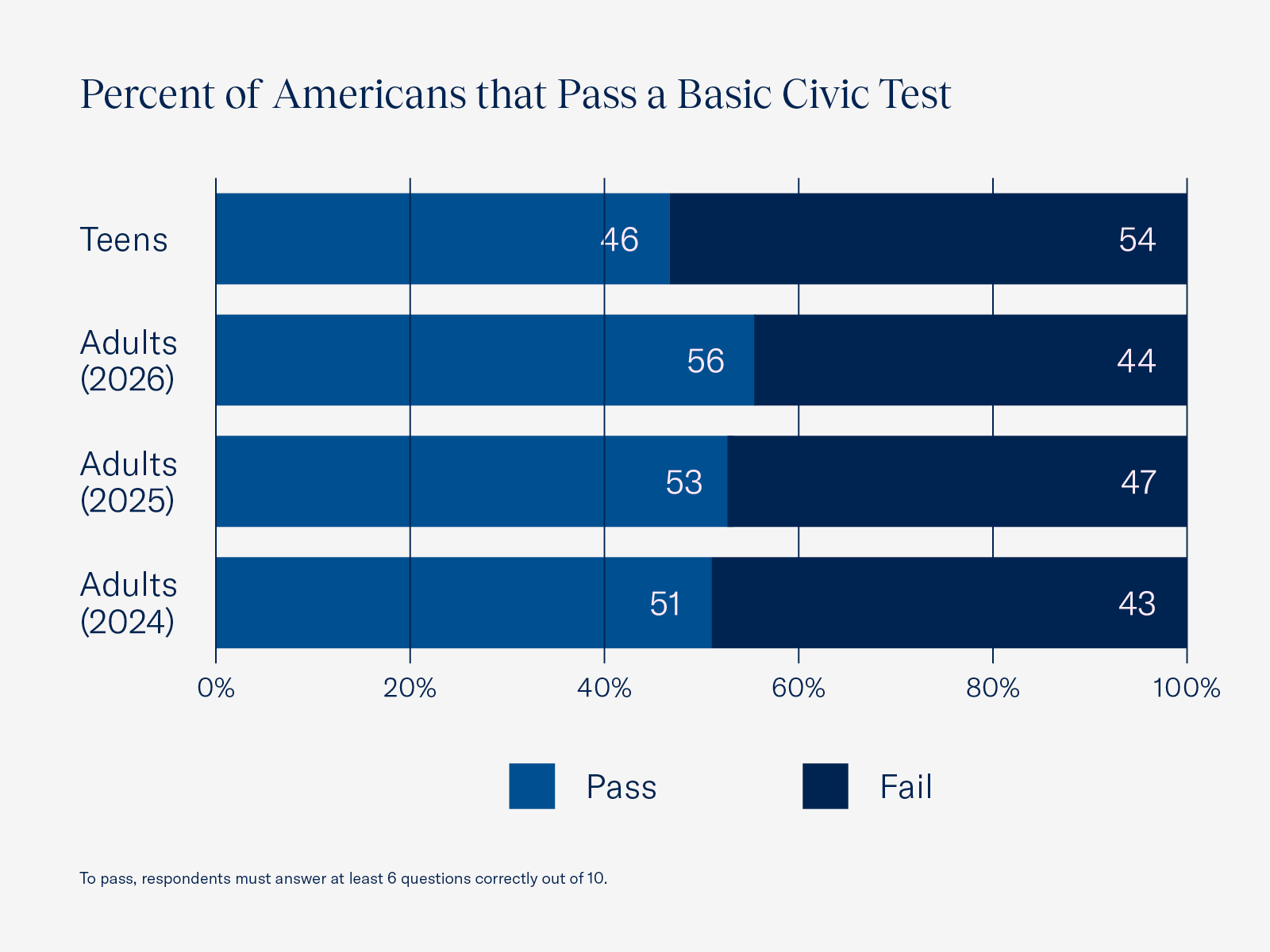
In 2026, performance varied considerably across individual questions. Adults demonstrated stronger understanding of highly visible aspects of government:
-
87%
correctly identified the two major political parties in the United States.
-
84%
correctly identified the president as the head of the executive branch.
-
75%
knew that the president serves as commander in chief of the military.
However, they were less likely to answer questions correctly about the structure and mechanics of government:
- 25% correctly identified the number of voting members in the U.S. House of Representatives.
- 44% correctly identified the branch of government where a bill becomes a law.
- 45% knew that U.S. senators serve six-year terms.
- 45% knew the number of justices on the U.S. Supreme Court.
Together, these results suggest that Americans are generally more familiar with prominent political figures and institutions than with the underlying structures, processes, and constitutional principles that shape how government operates.
The Knowledge Perception Gap Persists
There is a persistent gap between what people think they know and what they actually know. Despite low civic literacy scores, most Americans are confident they could explain how our government works to someone from another country. In our 2026 survey, adults were more confident than teens, with 68% expressing confidence compared to only 58% of teens.
The relationship between knowledge and engagement is complex. Americans want to participate, but interest in participation often outpaces understanding of the systems and issues that shape public life. Sixty-six percent of respondents with low civic literacy and 69% of those with low economic literacy said they were very likely to vote in future elections. On the other hand, respondents who reported being somewhat likely or not likely to vote were more likely to have low scores on both literacy tests. Half of these respondents answered four or fewer questions correctly on the civic literacy quiz and three or fewer questions correctly on the economic literacy quiz.
Taken together, the findings point to an important challenge: fostering not only participation but also informed participation. Closing the knowledge perception gap matters because informed participation depends first on understanding and then engagement. Strengthening civic and economic literacy can help individuals make informed decisions, understand trade-offs, and contribute more effectively to their communities.
Attitudes Remain More Positive Locally Than Nationally
Americans express more confidence in their local communities than in the country as a whole. While national issues often feel distant, complex, or divisive, local communities offer more tangible ways for people to participate, build relationships, and contribute to solutions they can see.
This distinction matters. Civic engagement does not happen only through elections or national politics. It also happens through volunteering, mentoring, serving on community boards, supporting local organizations, helping neighbors, and working with others to address shared challenges. These local forms of participation give people practical ways to strengthen civic life in their daily lives.
Local communities can serve as important sources of connection, resilience, and optimism. They provide opportunities for people with different perspectives to work together, build trust, and solve problems with a direct impact on daily life. At a time when many Americans see national civic life as strained, local engagement offers a constructive path forward: helping people experience civic participation as practical, personal, and relevant.
Economic Concerns Outpace Economic Understanding
Our economic and political systems are closely connected, shaped by institutions, policies, markets, and decisions that affect everyday life. Understanding how these factors interact can help people better interpret economic information and engage with issues that affect their communities.
Economic literacy jumped significantly from 2025 to 2026 with a nearly 20% increase in respondents passing the economic literacy test. Even with this increase, only 47% of adults and 49% of teens passed a basic economic literacy test, and only about one in 10 demonstrated the strongest levels of economic literacy measured by the survey. These shortfalls matter because Americans are making decisions every day as voters, workers, consumers, and community members.
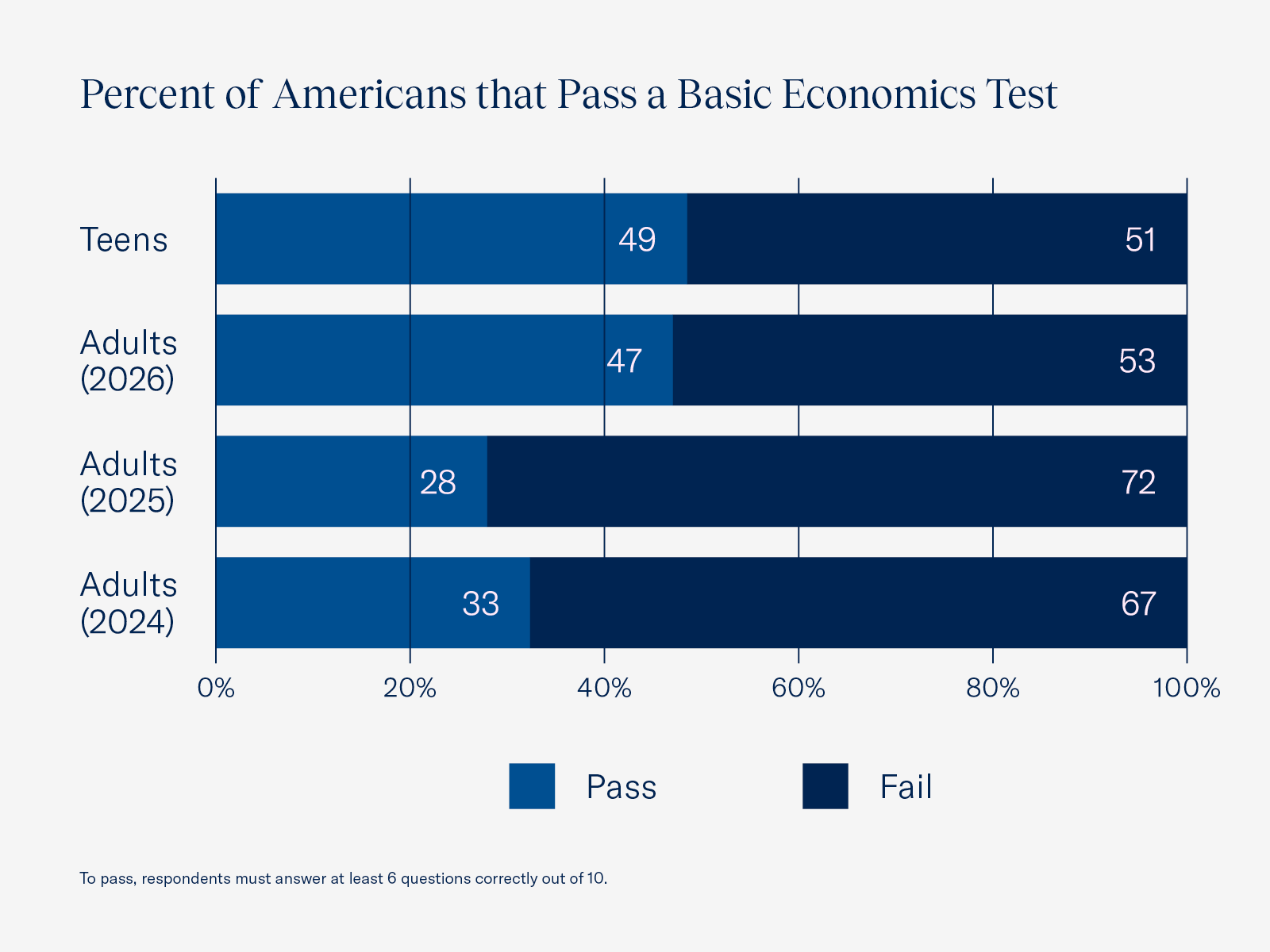
Adults performed best on practical concepts that relate to everyday economic experiences, such as entrepreneurship, inflation, income, and prices:
- 78% recognized that a person is worse off when prices rise faster than income.
- 73% correctly identified supply and demand as the force that sets prices in a market economy.
- 59% understood both how inflation works, and
- 59% understoodhow prices respond when demand exceeds supply.
They were less likely to correctly answer questions about the underlying principles of economic systems and market economies:
-
16%
of adults correctly identified the primary goal of an economic system as making the best use of scarce resources.
More adults selected incorrect answers such as balancing the government's budget (31%), balancing imports and exports (22%), or reducing the national debt (19%) than chose the correct response.
-
34%
correctly identified the quantity and quality of labor, capital, and natural resources as the primary limit on an economy’s potential output.
Economic Concerns Remain Consistent Across Survey Years
In 2025 and 2026, respondents consistently identified economic conditions, inflation, healthcare access and affordability, homelessness, affordable housing, and social support as areas of national concern. Managing the economy and inflation ranked as the top issue in all three years. Yet these concerns exist alongside notable gaps in economic knowledge.

These findings suggest that economic concerns are not only persistent, but also deeply practical. Respondents are focused on issues that affect household budgets, community stability, and everyday decision-making. Strengthening economic literacy can help people better understand the forces behind these concerns, evaluate information more confidently, and connect their personal experiences to broader economic trends.
The Next Generation Has Concerns, But Significant Optimism
Overall optimism that we can solve the issues facing our country remains high. Teens are slightly more optimistic than adults. Seventy-one percent of teens say the issues they believe deserve national attention can eventually be fixed, compared with 64% of adults. That optimism does not mean Americans are unaware of the country's challenges. Political division remains one of the most widely recognized obstacles to addressing our most pressing issues. In 2026, 89% of adults and 88% of teens said America is politically divided, continuing a trend that has remained remarkably consistent over time (85% in 2024 and 86% in 2025). Yet Americans are far less united on the personal consequences of that division. Nearly half of adults (47%) and teens (46%) said political division is a problem in their day-to-day lives, while an equal share said it is not.
Perceptions of division were highest among adults with stronger civic and economic knowledge. In 2026, 97% of adults with high economic literacy and 96% of adults with high civic literacy said America is politically divided, compared with 89% of adults overall.

A Failing Report Card: We Are Performing Poorly on the Building Blocks to Our Nation’s Success
The survey shows striking agreement between adults and teens on several building blocks of civic life. One of the strongest areas of consensus is support for small businesses. More than nine in ten adults (91%) and teens (90%) view supporting small businesses favorably. At a time when trust in many institutions is strained, this finding suggests that local economic life remains a rare source of shared confidence and optimism across generations. Small businesses are often woven into the fabric of communities, providing not only economic opportunities but also places where people connect, contribute, and invest in their neighbors. While adults place somewhat greater emphasis on voting, teens are more likely to highlight cross-perspective listening as a key ingredient of a healthy society.
More broadly, adults and teens continue to place a high value on the civic knowledge and behaviors that strengthen communities and democracy. However, perceptions of how well these civic values are being practiced have declined. Compared to 2025, adults rated the nation lower across every civic indicator measured, with some of the steepest declines occurring in civics education and understanding how the American system of government works.
Notably, the areas Americans rate as most important are often the same areas where they see the greatest room for improvement. Only 55% of adults and teens believe the country is doing well at helping people understand how our system of government works, despite ranking that knowledge among the most important contributors to national success. Similarly, fewer than half of adults and teens (49%) believe the country is doing well at encouraging people to listen to those with different viewpoints, even though more than nine in 10 believe it is important to our success.
The good news is that the findings point to a clear path forward. Americans largely agree on the values and behaviors that contribute to a strong society, even when they disagree on politics. The gap between the importance they place on these civic foundations and their perceptions of current performance highlights an opportunity to expand participation. Whether through civic education, community service, volunteering, constructive dialogue, local leadership opportunities, or workplace-based civic initiatives, Americans need accessible pathways to develop the knowledge, skills, and relationships that strengthen civic life. Closing the gap between importance and performance will require more than information alone. It will require creating meaningful opportunities for people to participate, contribute, and experience the value of civic engagement firsthand.
Including Teens in 2026: The Future Generation is Taking Part Now
Young Americans are highly aware of current civic challenges and recognize gaps between the values they believe are important and how effectively those values are being practiced.
Perhaps most encouraging, teens appear eager to engage when meaningful opportunities are available. Community leaders interviewed as part of this research consistently pointed to growing interest among younger generations in community service, volunteering, civic leadership, and hands-on involvement in local issues. Together, the survey and interviews suggest that rather than rejecting civic participation, many teens are open to practical ways to make a difference in their communities.
That combination matters to educators, employers, policymakers, and community leaders. Young people are paying attention and eager to engage. The question is whether they will be given enough meaningful opportunities to build knowledge, test ideas, and see themselves as part of civic life.
How Do We Move Forward? Give People a Place to Practice
The data does not suggest that civic confidence can be rebuilt through information alone. People also need opportunities to practice the habits democracy requires: listening across differences, asking better questions, understanding tradeoffs, and working with others to solve real problems.
These are not only civic skills. They are also skills workplaces and communities depend on: critical thinking, communication, problem-solving, collaboration, and the ability to navigate disagreement productively. Employers have a direct stake in whether young people and adults are prepared to participate constructively, not only as voters but also as workers, consumers, neighbors, and community leaders. Companies, chambers of commerce, educators, and community organizations are uniquely positioned to help close that gap by creating opportunities for civic learning, constructive dialogue, community service, and local problem-solving.
Through the U.S. Chamber Foundation's The Civic Trust, the National Civics Bee helps students deepen their understanding of government, identify local challenges, and develop solutions. Civics@Work helps employers build civic knowledge and engagement in the workplace, preparing employees to contribute as informed workers, neighbors, and community leaders.
The survey's most encouraging finding is not that Americans agree on everything. They do not. It is that Americans of all ages still share a commitment to the values that strengthen communities and democracy. By expanding opportunities for civic education, engagement, and participation, we can help translate those shared values into action and build stronger communities and a stronger nation.

Methodology
The Civic Trust’s annual survey examines Americans’ civic and economic knowledge, attitudes, and participation. The study is designed to provide a national snapshot of how Americans understand key civic and economic concepts, perceive the health of their communities and democracy, and engage in civic life. All surveys were conducted by RXN Group and weighted to reflect the demographic composition of the target populations. Findings should be interpreted within the stated margins of error, which are larger for demographic and attitudinal subgroups.
2024 Survey
The 2024 survey was conducted among a national sample of registered adult voters in the United States.
- Field dates: February 21-28, 2024
- Sample size: 1,000 registered adult voters
- Margin of error: ±3.1 percentage points
- Confidence level: 95%
2025 Survey
The 2025 survey was conducted among a national sample of registered adult voters in the United States.
- Sample size: 1,000 registered adult voters
- Field dates: June 2-9, 2025
- Margin of error: ±3.1 percentage points
- Confidence level: 95%
2026 Survey
The 2026 survey expanded the study to include both adults and teens in the United States, allowing for direct comparisons between generations on civic knowledge, economic literacy, attitudes, and participation.
- Adult sample: 1,000 registered adult voters
- Teen sample: 1,000 teens ages 13-17
- Field dates: April 24-May 11, 2026
- Margin of error: ±3.1 percentage points for each sample
- Confidence level: 95%
Interpreting the Results
Throughout this report, percentages may not always total 100% because of rounding. Differences between groups or across years should be interpreted considering the surveys' margins of error. Unless otherwise noted, references to adults are based on the national sample of registered voters, while references to teens are based on the national sample of Americans ages 13-17 surveyed in 2026.
The findings presented throughout this report describe attitudes, perceptions, and self-reported behaviors at the time the surveys were conducted. They identify patterns and relationships among civic knowledge, economic literacy, and civic engagement but do not establish causal relationships. Where differences emerge across demographic, political, or knowledge-based groups, these findings should be understood as associations rather than evidence that one factor directly causes another.
Get the latest news and resources aimed at improving understanding of and involvement in American civic life delivered straight to your inbox.