



Published
November 19, 2026
A Field Guide for Employer Coalitions, Industry Associations, and Sector Partnerships
Your coalition has done the hard part. Employers in your sector have come together, agreed on where their hiring needs are greatest, and begun speaking with one voice about what it takes to fill those jobs. But you may be finding that the public education, training, and workforce systems around you aren’t set up to hear your coalition’s priorities and act on them.
Most of what public systems ask of employers comes one program and one request at a time: a seat on an advisory committee, a letter of support, or a signature on a grant application. A coalition can offer something those requests aren’t designed to capture: a clear view of where the sector’s hiring needs are heading, and recommendations on which programs to build and which barriers to clear.
This guide is for coalitions whose employers have already organized around shared hiring needs – whether through the U.S. Chamber of Commerce Foundation's Talent Pipeline Management® (TPM) framework, an industry association, or a sector partnership. Your employers may have projected their demand, defined the requirements for their critical jobs, and built early partnerships with education and training providers.
That work gives a coalition a strong base for the next step: gaining a role in the decisions public systems make across a state or region, such as what they fund, approve, license, and adopt as a standard. The five moves below help a coalition move from advising individual institutions to recommending where the broader workforce development ecosystem should focus, each with a tool to use and an example of a coalition that has done it. The moves can be taken in any order.
About this guide. It draws on the work of the Industry-Led Talent Initiative, a group of fourteen workforce leaders from across the country who met through the first half of 2026 to examine how employers can take a more meaningful role in public education, training, and workforce systems. Ashley Carter and Kelly Vedi convened the group, and Jaimie Francis, vice president of programs and policy at the U.S. Chamber of Commerce Foundation, was one of its members. The tools and case studies linked throughout this guide were developed by the group and are published on its site, industryledtalent.org.
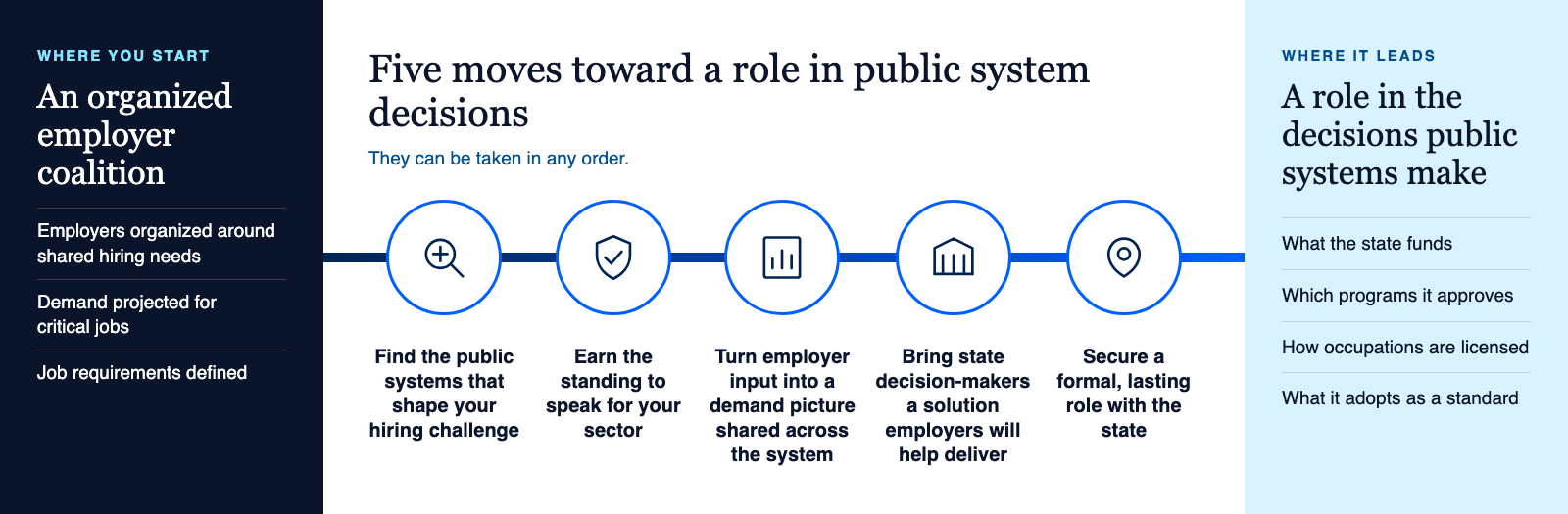
Find which public systems shape your hiring challenge
Your coalition's work has likely already surfaced the hiring challenge your employers share most – the jobs they most need to fill, and the skills those jobs require. The next question is who in the public system can help solve that challenge. Most hiring challenges cut across several public systems: high school career programs, community and technical colleges, apprenticeship, and workforce boards. Each system makes different decisions, on a different calendar, with different funding. Knowing which system decides what can save a coalition months of meetings with partners who cannot make the change it needs.
The system navigator developed by the Industry-Led Talent Initiative is built to help a coalition sort out which systems make which decisions. Choose a hiring challenge, and it shows which public systems to engage and what to ask of each.
Colorado's construction employers faced a problem that spanned three systems. High school construction courses, registered apprenticeships, and college credentials ran as separate tracks, and too many workers stalled in entry-level jobs. A task force of twenty employers met eighteen times over two years, working through the TPM process, and found that the shortage was in plumbers, pipefitters, and electricians – a different picture from the one programs had been built around. Their answer, Project SCALE, connects the tracks the state already had into one pathway, with credentials that stack toward a degree.
Read the Colorado case study.
Earn the standing to speak for your sector in the eyes of the state
States are more likely to act on input from organizations they trust to represent a whole sector. That trust rests on five conditions, described in What makes an effective sector intermediary: broad and representative employer engagement, legitimacy and trust with employers, deep and sustained employer involvement, the ability to translate employer needs into solutions, and real expertise in the sector.
In Phoenix, the Greater Phoenix Chamber Foundation convened nine hospitals into an employer-led collaborative built on TPM. Using their own hiring projections, the hospitals named six specialty nursing areas as most urgent and worked with the Maricopa County Community College District on the program requirements. Because the case they brought to policymakers came from nine hospitals speaking together, with a college ready to deliver, it had weight that separate requests would not have had. The state provided nearly $6 million to stand up the new programs, and within about a year more than 300 working nurses had completed training in the first two specialties.
Standing in the eyes of the state also comes from raising priorities that aren't yet on the system's agenda. Employers' most urgent issues often sit outside the work of education and training systems – security clearance backlogs in aerospace, or pay for the nurses who supervise students in healthcare. When a coalition brings issues like these forward, the state learns that it can count on the coalition for insight it would not get from labor market data, surveys, or individual employers.
Read the Phoenix case study.
Turn employer input into a demand picture shared across the system
The Industry-Led Talent Initiative offers a tool it calls a demand picture: a single statement of the jobs a sector is hiring for, the skills those jobs require, and the credentials employers use in hiring. A demand picture can be written for every institution that prepares people for the sector – high schools, colleges, apprenticeship programs, and workforce boards – so that each can work from the same picture. A coalition can share it broadly with those institutional partners and keep it current, in place of answering separate requests from each of them.
This sample sector demand picture shows what one could look like. Use the tabs across the top – Overview, Demand and supply, Skills, Credentials, and Strategies – to see each component of the sample picture. As AI and other technologies change tasks and skill requirement within jobs, a demand picture can help employers signal those changes before they appear in published labor-market data.
In Ohio, more than 45 manufacturers in the Ohio Manufacturers' Association built a shared competency model for operator and technician roles: more than 400 rated statements of the knowledge, skills, and abilities those jobs require. Ohio's Department of Education and Workforce adopted the framework.
Read the Ohio case study.
Bring state decision-makers a solution employers will help deliver
This move is aimed at the state-level systems that make decisions for many institutions at once: the agencies, boards, and legislatures that fund programs, approve them, license occupations, and set standards. Decision-makers at that level hear about problems all the time. What helps them act is a clear solution from the employers who will do the hiring and training – what is holding back the sector's talent pipeline, the change that would address it, who would need to act, and what employers will commit in return, whether hiring, training, or co-investment. A recommendation in that form can give state decision-makers something more actionable than a request from an agency or training provider alone.
The strategies section of the sample demand picture shows what these types of solutions can look like, with each barrier paired with a strategy, the people who would act, and what employers commit alongside.
In Alabama, the state’s apprenticeship agency and community colleges tried to build a nursing apprenticeship, but the effort stalled. The Board of Nursing was hearing about the idea almost entirely from public agencies and training providers, as opposed to the employers who would hire the nurses. That changed when the Alabama Hospital Association and the Alabama Nursing Home Association organized hospitals, nursing homes, and long-term care providers behind it. The associations worked with the Board to design a nurse apprentice permit, and with the legislature to give the Board the power to create it. Employers also committed to hiring the apprentices and covering the last dollars of their training costs. The pathway now enrolls more than 1,000 nurse apprentices across about 90 employers and 28 colleges and universities.
Read the Alabama case study.
Secure a formal, lasting role with the state
The last move is to make the coalition's role outlast a single project. That can take several forms: a formal designation from the state, a defined role in decisions about programs and funding, or funding for the coalition's core work.
Washington state did all three. Through Career Connect Washington, the state selected and funded ten sector intermediaries, called Sector Leaders, and wrote the role into statute. Its Employment Security Department then revised its grant criteria to align with the strategies the Sector Leaders developed. In Indiana, philanthropy took the first step: the Richard M. Fairbanks Foundation has provided funding to stand up Industry Talent Associations, which employers in each industry must match, and ten industries have taken on the role since 2024.
For a coalition making the case for support, the Industry-Led Talent Initiative’s funding guide lays out three areas of work a state can fund – the organization's core work, the strategies it recommends, and the programs it runs – and potential sources that can pay for each.
Read the Washington and Indiana case studies.
Wondering where to begin?
If your coalition isn't sure which move to make first, open the system navigator, pick the hiring challenge your employers raise most often, and see which public systems shape it. That one step will tell you whom to approach and what to ask for. The full set of tools and fourteen case studies is at industryledtalent.org.
Your coalition already knows what its employers need. When coalitions help state-level public systems see where to act, they can better align training, policy, and investment with the jobs employers need to fill.
The examples in this guide come from cases contributed by members of the Industry-Led Talent Initiative.


