
USCCF New Data Paradigm Summary Nov2026
USCCF New Data Paradigm Technical Report
Published
November 19, 2026
A New Foundation for Opportunity
People build skills throughout their lives: in school, training programs, jobs, military service, and other experiences. But the information that documents those skills often lives in different systems that were not designed to work together. That can make it harder for people to demonstrate what they know and can do, for employers to find the talent they need, and for education and training providers to keep pace with changing workforce needs.
The New Data Paradigm (NDP), an initiative of the U.S. Chamber of Commerce Foundation's T3 Innovation Network, is exploring a better approach: a more connected, secure, and people-centered system for education and workforce data. The goal is to give individuals greater ability to access and use trusted information about their education, skills, and work experience, while giving employers, educators, communities, and government better information for decision-making.
Why a New Approach is Needed
Today's education and workforce data systems play an essential role in government programs, statistics, research, and policymaking. But many were created primarily for reporting and analysis, rather than to give individuals easy access to their own information or to support the growing number of tools used to navigate education and employment.
At the same time, how people learn and work is changing. Skills are acquired across many different experiences and institutions, technology is creating new ways to connect people with opportunities, and employers and education providers need more timely information about an economy that is evolving quickly. NDP explores how existing systems could be connected and strengthened to meet those needs without sacrificing privacy or security.
At the center of that vision are learners and workers themselves.
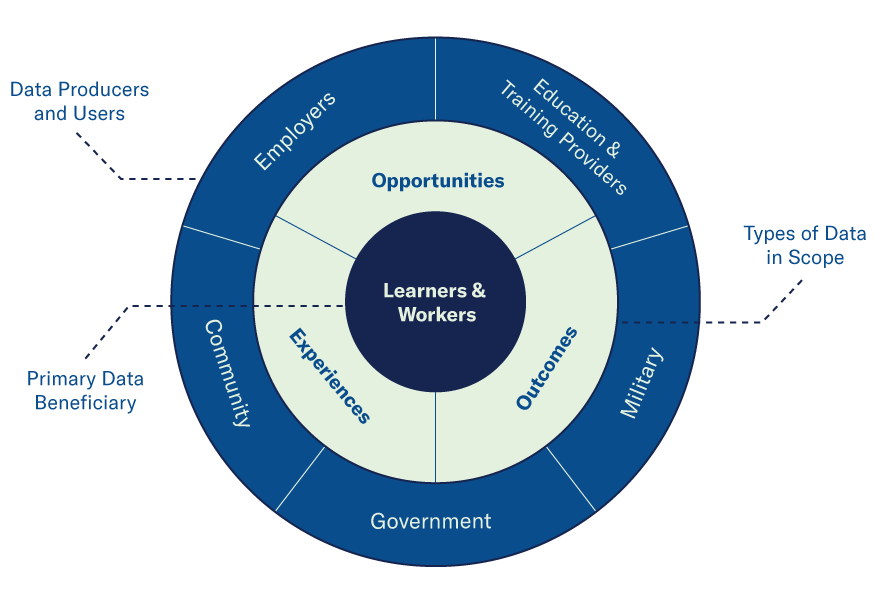
Employers, education and training providers, government, the military, and communities all create or use information about people's opportunities, experiences, and outcomes. NDP explores how that information could connect more effectively and securely, with learners and workers as its primary beneficiaries.
From Vision to a Practical Framework
The new New Data Paradigm Technical Report captures the results of the initiative's planning phase and lays out an initial framework for moving from concept to implementation. The report explores a public-private data and technology infrastructure that could support more consistent education and employment information while expanding the ways individuals and organizations can securely use it.
Rather than creating one centralized system, the proposed approach would connect and improve the systems already used by employers, education providers, government agencies, and other organizations. Shared standards and services could help those systems exchange information more consistently while maintaining privacy and security protections.
In practical terms, that could make it easier to:
- Give people access to trusted records of what they know and can do, including education, skills, credentials, and work experience.
- Make job and learning opportunities easier to find and compare by using more consistent ways of describing jobs, programs, credentials, and skills.
- Help employers and education providers speak a common language about skills, making it easier to connect people's abilities with jobs and learning opportunities.
- Reduce duplication and improve data quality by modernizing and coordinating how employers and education providers report information.
- Enable new AI-powered tools and services that can help individuals explore career and learning pathways using trusted information, while protecting privacy.
What the Report Recommends
The planning phase identified three areas where the initiative can begin turning the NDP vision into something that can be designed and tested.
Create a common language for education and employment data. Different systems often describe the same information in different ways. NDP proposes working with standards organizations, government, and industry partners to better align how education, employment, credentials, and other information are defined and exchanged.
Connect the many ways organizations describe skills. There is no single vocabulary for skills. Employers, education providers, governments, and technology platforms may describe similar abilities differently. NDP will explore standards and translation tools that could make those descriptions more comparable, helping connect people with jobs and learning opportunities.
Design and test public-private partnerships across states. NDP will explore how public and private organizations could work together across state lines to provide trusted data services. Pilot efforts would test governance, privacy, security, data sharing, and practical applications before any broader implementation.
The technical report lays out a longer-term roadmap that moves from design in 2026-2027, to pilot testing in 2027-2029, to broader implementation of approaches that prove successful beginning in 2029.
Building the Infrastructure for What's Next
The New Data Paradigm is ultimately about making information work better for people.
With more trusted, consistent, and secure education and employment data, workers could have an easier way to demonstrate their skills and experience. Employers could gain better information for finding talent. Education and training providers could better understand what skills are needed. Communities and public agencies could make decisions using more timely information. And new technologies, including AI-powered tools, could help people navigate an increasingly complex world of work and learning.
The planning phase provides a starting point, not a finished system. The next phase will bring together employers, education and training providers, government agencies, standards organizations, technology partners, and other stakeholders to design and test the approach and determine what works.


